Loading cinematography
Monday, 30 November 2015

Thursday, 15 October 2015

Monday, 12 October 2015
Wednesday, 4 February 2015
When you are shooting with DSLR, there are some specific considerations that you need to take into account - this is not a standard HD video camera.
The main issues that students encounter relate to keeping the image focussed and keeping the image stable enough to remain watchable.
Focus.
There are few easy answers. The main reason that DSLR cameras have become popular as video cameras is a seemingly intangible 'filmic' or 'cinematic' quality. A lot of this is attributed to 'depth of field.'
Depth of field
As you focus your camera on your subject, there is a zone in which that subject can then move, either towards or away from the camera and still remain in reasonable focus. This is termed the depth of field of an image. This is determined by two factors: the size of the sensor (the light-sensitive silicon chip) inside the camera, the magnification of the lens. It can be manipulated by a third factor: the iris/aperture setting, usually measured in 'f stops'.
The bigger the camera's sensor, the more exaggerated the depth of field effect can be. This is connected to factor two: the magnification of the lens. There is an interaction between the focal length of a lens (the measurement of how the lens magnifies or reduces an image) and the size of sensor inside the camera.
If I were to put a lens from my DSLR onto a normal video camera, it would not give me the exact same image as the DSLR. The sensor in the DSLR is much much bigger than that of the average standard video camera. The lens and the sensor size are interconnected in how they affect the depth of field.
Take the example of filming a mid close-up of a subject on a DSLR and a normal video camera, side by side.
in order to get the 'framing' on a DSLR to match the framing of a shot on a standard hd video camera, you would need to use different a magnification of lens. The larger sensor in the DSLR would need to be fitted with a greater magnification of lens in order to achieve that same mid close up as the standard video camera.
The more the image is magnified, the more the lens exaggerates the blurred effect of the out-of-focus parts of the image and the smaller that area of the depth of field will be. Any image shot on a lens with a greater magnification, i.e a telephoto lens or a zoom that is more zoomed in, will show a more dramatic depth of field effect whichever camera you use, small or large sensor, but as you may have already realised, that effect will be even more exaggerated on a DSLR with a bigger sensor.
There is however a third factor that can affect the depth of field in an image. This is the iris/aperture setting. In a video camera the setting is called 'iris', in a DSLR it is called 'aperture' (as with any still image photography). They both are measured in 'f stops'.
Each stop, which is traditionally a clickable position on the lens of a camera, is changing the amount of light travelling through the lens by opening and closing a series of interleaving fine metal blades that create an opening which can be made larger or smaller to allow more or less light through onto the sensor.
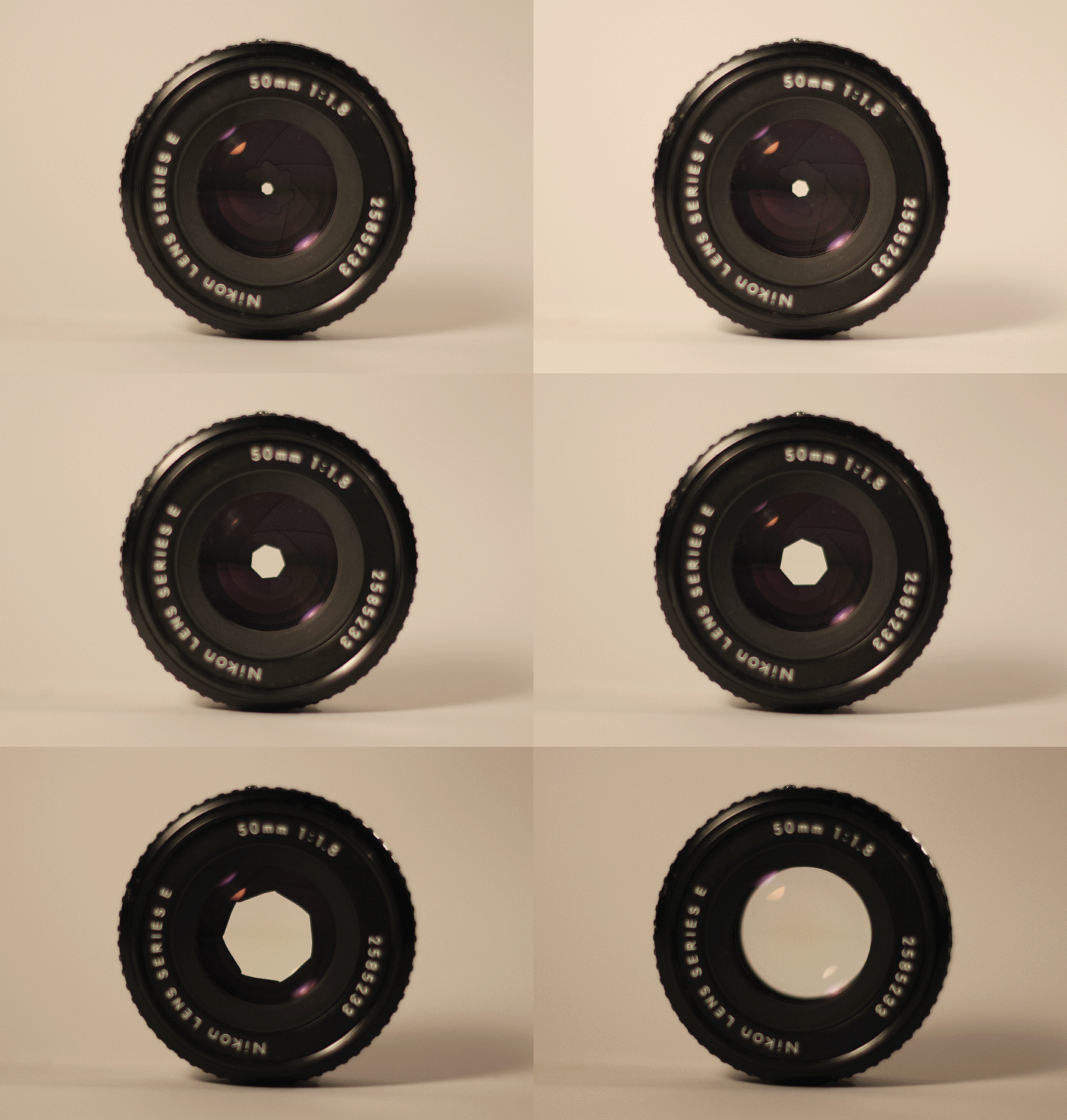
This is the main means of getting the correct exposure of the image for a camera operator but it also has an effect on the depth of field. A smaller opening of the aperture/iris, which is denoted by a higher 'f'number creates an image with more depth of field. The smaller iris/ aperture has an additional focussing effect on the light, in the same way that at the extreme end of this principle, a pinhole camera can create a sharp image without having a glass lens.

This can mean that in bright light it is much harder to create low depth of field effects and in low light, it can become harder to create a larger area of depth of field.
One practical consequence of using a DSLR to shoot video is that it becomes much harder to keep the image in focus. In a high budget movie, there is a person on the crew called a focus puller whose only job is to ensure that the shots are in focus. As low budget film makers, this is often an additional job for the camera operator.

A change in focus without re-composing the shot i.e a focus pull or rack focus can be used to direct the eye of the audience within the composition.

Most film makers have to rely for focus on the small screen on the back of the camera. This can be deceptive. There are some aids to getting good focus. The main aid to focus on the camera is a setting enabling the user to zoom in on part of the image and fill the screen with that small section of the whole shot, to ensure that important detail of the composition is in focus before shooting.

On many cameras you can only do this before you start filming.
Many DSLR shooters use a magnifier attached to the back of the camera to turn the rear preview screen into an ad hoc viewfinder since the normal viewfinder does not work in video mode :-
image: eos-network.com

Stability
The second challenge that most film makers face is stabilising the camera for smooth shots.
The default should be tripod images. It is a fallacy that hand held camera work is technically closest to the point of view. It is simply a shorthand for point of view which the audience has come to accept over time. However our own personal viewpoint on the world is far steadier. Tripod shots should be considered the default point of view that the audience will expect and anything other than that is an additional stylistic effect intended to communicate specific information to the audience about the viewpoint on the action.
If you do need to shoot handheld on DSLR, it is always better to try and use a wider angle lens(or zoom out on a zoom lens). If this means that you need to move in closer to the action in order to achieve closer framings. Provided you are not filming anything hazardous (e.g tigers), then go for it. The unsteadyness of your handheld camerawork will be lessened on a wider lens. There is a whole industry surrounding camera stabilisation, it is the sole job of the Grip on a feature film set: to provide a means of holding a camera steady - that alone should communicate the importance of keeping the camera stable
example of stabilisation 'rig' for a DSLR

You don't need to shop for solutions, ingenuity and resourcefulness are qualities that are highly prized within the film making community.

If you don't take care with your images there are a few flaws in DSLR shooting that can become apparent. The main one relating to the stability of the camerawork is the Rolling shutter effect.


If I were to put a lens from my DSLR onto a normal video camera, it would not give me the exact same image as the DSLR. The sensor in the DSLR is much much bigger than that of the average standard video camera. The lens and the sensor size are interconnected in how they affect the depth of field.
Take the example of filming a mid close-up of a subject on a DSLR and a normal video camera, side by side.
in order to get the 'framing' on a DSLR to match the framing of a shot on a standard hd video camera, you would need to use different a magnification of lens. The larger sensor in the DSLR would need to be fitted with a greater magnification of lens in order to achieve that same mid close up as the standard video camera.
The more the image is magnified, the more the lens exaggerates the blurred effect of the out-of-focus parts of the image and the smaller that area of the depth of field will be. Any image shot on a lens with a greater magnification, i.e a telephoto lens or a zoom that is more zoomed in, will show a more dramatic depth of field effect whichever camera you use, small or large sensor, but as you may have already realised, that effect will be even more exaggerated on a DSLR with a bigger sensor.
There is however a third factor that can affect the depth of field in an image. This is the iris/aperture setting. In a video camera the setting is called 'iris', in a DSLR it is called 'aperture' (as with any still image photography). They both are measured in 'f stops'.
Each stop, which is traditionally a clickable position on the lens of a camera, is changing the amount of light travelling through the lens by opening and closing a series of interleaving fine metal blades that create an opening which can be made larger or smaller to allow more or less light through onto the sensor.
This is the main means of getting the correct exposure of the image for a camera operator but it also has an effect on the depth of field. A smaller opening of the aperture/iris, which is denoted by a higher 'f'number creates an image with more depth of field. The smaller iris/ aperture has an additional focussing effect on the light, in the same way that at the extreme end of this principle, a pinhole camera can create a sharp image without having a glass lens.
This can mean that in bright light it is much harder to create low depth of field effects and in low light, it can become harder to create a larger area of depth of field.
One practical consequence of using a DSLR to shoot video is that it becomes much harder to keep the image in focus. In a high budget movie, there is a person on the crew called a focus puller whose only job is to ensure that the shots are in focus. As low budget film makers, this is often an additional job for the camera operator.
Image: "the black and blue"

A change in focus without re-composing the shot i.e a focus pull or rack focus can be used to direct the eye of the audience within the composition.

Most film makers have to rely for focus on the small screen on the back of the camera. This can be deceptive. There are some aids to getting good focus. The main aid to focus on the camera is a setting enabling the user to zoom in on part of the image and fill the screen with that small section of the whole shot, to ensure that important detail of the composition is in focus before shooting.
On many cameras you can only do this before you start filming.
Many DSLR shooters use a magnifier attached to the back of the camera to turn the rear preview screen into an ad hoc viewfinder since the normal viewfinder does not work in video mode :-

Stability
The second challenge that most film makers face is stabilising the camera for smooth shots.
The default should be tripod images. It is a fallacy that hand held camera work is technically closest to the point of view. It is simply a shorthand for point of view which the audience has come to accept over time. However our own personal viewpoint on the world is far steadier. Tripod shots should be considered the default point of view that the audience will expect and anything other than that is an additional stylistic effect intended to communicate specific information to the audience about the viewpoint on the action.
example of stabilisation 'rig' for a DSLR

You don't need to shop for solutions, ingenuity and resourcefulness are qualities that are highly prized within the film making community.
If you don't take care with your images there are a few flaws in DSLR shooting that can become apparent. The main one relating to the stability of the camerawork is the Rolling shutter effect.
Because the sensor is bigger, the time it takes for the camera to scan the information off each line of the camera can become visible should you move the camera about too violently. The vertical lines of the buildings in the shot start to 'sway', it is sometimes nicknamed the 'Jello' effect. This is less obvious on some cameras than it is on others, but it is wise to be cautious with your footage.
So, to return to why DSLRs have become so popular. Because the depth of field is lessened, it becomes easier to isolate a subject from the distractions of a background over which a film maker may not have control. There are other ways to create depth in a shot: composition, lighting, movement, art direction, but it is sometimes easier to just use narrow depth of field to blur it out. A word of caution however: Easier is not necessarily better.
Another advantage of using DSLR is clear: it is able to shoot good images in low light. The sheer size of the sensor improves its ability to absorb the light falling on its surface. This improved light sensitivity combined with the wide range of lenses that can be attached to the camera, some of which also increase the amount of light falling on the sensor, increases the range of possibilities for the low budget film maker with limited access to lights.

When looking at a DSLR image on a smaller screen, some of its flaws are less obvious, but on looking at those same images on a large scale projection, it can become apparent that there are two other issues that can frequently be present in DSLR footage.
Aliasing and Moire.
The sensor is covered with an array of small light sensitive receptors. On a DSLR, there are gaps between the receptors due to the additional size of the sensor. This creates a pattern of lines in the image. Ordinarily this pattern is so fine that is is not detectable, but it can interfere with lined patterns in the subject to create interference effects, called aliasing and moire patterns.
This is not present in every image and there are precautions that you can take to reduce the prevalence of moire and aliasing, but it is an issue to be aware of: avoiding certain patterns in fabrics for instance:-
Further notes on DSLR
Camera Profiles
The video within a DSLR is heavily compressed as it is output onto the card. They are stills cameras primarily. in order to preserve as much quality as possible within the footage, film makers have used the facility to put a 'picture profile' into the camera.
Technicolor were one of the first to develop a tool for DSLR shooters and made it freely available. Cinestyle is loaded onto the camera via a memory card. It is designed to take as much of the colour data from the signal which the sensor outputs and preserve it on the recorded footage. This makes the untreated footage appear washed out. The contrast and any other colour effects can be 'graded' into the footage afterwards by the editor. This does slightly improve the final image, even though it adds further complications. There are similar picture profiles available from other sources with the same intention. Should you choose to adopt this tactic, always check with your editor before shooting.

Because the image looks washed out, it can fool the eye of the camera operator. As a working process, if time allows, I make sure that the exposure is correct in the 'standard' picture profile, using the histogram make sure that the bright areas of the image are not too bright, and when ready to film, switch into Cinestyle. There is no 'zebra' setting on a dslr as there is on a video camera, so the histogram is the only option available.
The above histograms are measuring images that are too dark and too bright. Below is much better. The main use of a histogram is to make sure that the brightest parts of the image do not bunch up on right hand side of the histogram so that the white areas 'clip'. Test, test and test again...

Iso and White balance
'Iso' is called 'gain' on a video camera and whilst it is possible to use higher gain settings on a DSLR, there is always an acceptable limit. Mid range Iso settings are around the 320 to 400 range on a DSLR. Be conservative and shoot tests, it is generally only possible to see the worst effects of gain on an image when looking at the footage on a bigger screen, generally when it is too late.
White balance can be measured, but it is a slower process on a DSLR, it is common practise to dial in a number (measured in K). The higher the number for outdoors light, lower for traditional style indoor lightbulbs.


Hacking
Many of the popular DSLRs used by film makers (chiefly Panasonic and Canon) have been hacked by keen film makers. There are risks in doing this, but thousands of cameras are successfully being used with these hacks. This software can expand the range of features and the performance of these cameras, but they are at the users own risk.
The main challenge is to get the know the specific camera well before working on it. Shoot tests and look at the results in an edit suite. There are many forums online hosting conversations between keen users about all aspects of shooting and issues specific to these cameras. Remember that many of the automatic features available when using these cameras as still image cameras are not available in the video modes, there is no replacement for familiarity with the equipment.
Subscribe to:
Posts (Atom)